Serious Injuries
Whiplash & Neck Injuries
This page was created as a general resource for auto accident victims searching for an understanding of whiplash, how it’s classified, what causes it, and what treatment and recovery typically look like.
Whiplash is one of the most common injuries resulting from motor vehicle collisions and, unfortunately, also one of the most misunderstood. Because it’s a soft tissue injury that frequently doesn’t appear on standard imaging tests, whiplash and other related neck injuries occupy a strange place in both medicine and personal injury law: they’re well-documented in medical publications and courtroom findings, yet routinely minimized or dismissed by insurance companies when evaluating claims.
Attorney Matt Boulton has represented Indiana accident victims with neck injuries ranging from mild strain to severe disc herniation for more than 30 years, and this library page draws on both his legal experience and established medical literature on the subject.
Anatomy of the Neck: A Brief Overview
The cervical spine consists of seven vertebrae (C1 through C7), separated by intervertebral discs that act as shock absorbers. Surrounding the vertebrae is a network of muscles, tendons, ligaments, and nerve roots responsible for supporting the head, enabling a wide range of motion, and transmitting nerve signals between the brain and the rest of the body.
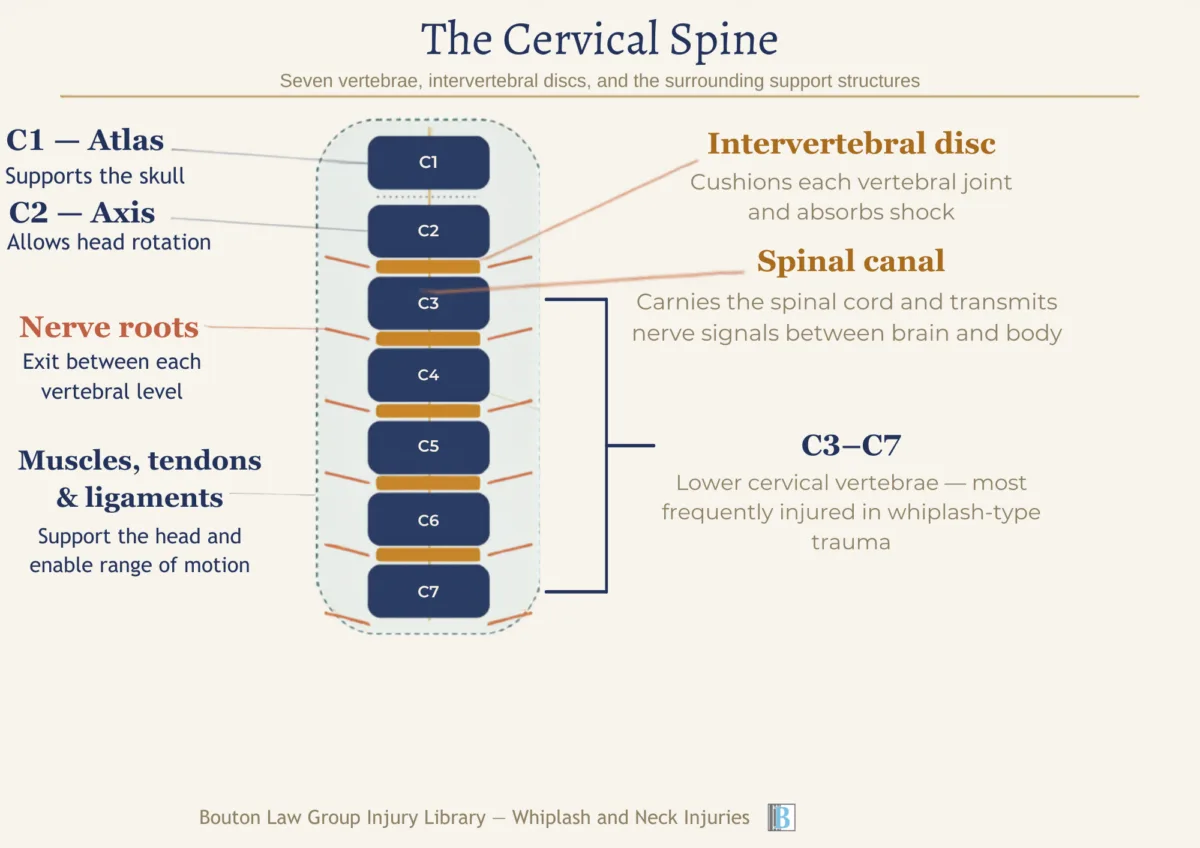
Because the neck is both highly mobile and relatively unprotected compared to other parts of the spine, it’s particularly vulnerable to the rapid acceleration-deceleration forces generated in a vehicle collision.
What Is Whiplash? Mechanism of a Common Injury
Whiplash refers to an injury of the neck caused by a rapid back-and-forth or side-to-side motion of the head relative to the torso, most often the result of a rear-end or side-impact collision. The clinical term for this mechanism is cervical acceleration-deceleration, sometimes abbreviated as CAD.
During a rear-end collision, the torso is accelerated forward by the seat while the head, unsupported for a fraction of a second, initially lags behind. This creates a rapid extension of the neck, followed almost immediately by a forceful forward flexion as the head catches up and overshoots. The entire sequence typically occurs in a fraction of a second and generates forces on the cervical spine that can exceed what the surrounding muscles, ligaments, and discs are able to absorb without injury.
Research published in medical literature indicates that whiplash injuries occur in a substantial percentage of motor vehicle collisions, with some studies estimating that the majority of occupants involved in a collision experience some degree of cervical acceleration-deceleration force, though not all develop symptoms severe enough to require extensive treatment.
Similar studies have also demonstrated that a whiplash injury can occur at low speeds, including collisions under 10 miles per hour, and that the degree of visible vehicle damage does not reliably predict the severity of the underlying injury to the occupant.
Attorney Boulton has helped a number of clients who sustained whiplash injuries in low-speed accidents, sometimes referred to as MIST cases, minimal impact soft tissue collisions. These cases are often a result of rear-end collisions and result in minimal property damage. This can be especially true in trailer-hitch truck accidents, resulting in pushback from insurance companies over injury claims.
Classification of Whiplash-Associated Disorders (WAD)
In clinical and medicolegal settings, whiplash injuries have long been classified using the Quebec Task Force (QTF) grading system, which categorizes whiplash-associated disorders based on the presence and severity of physical and neurological findings.
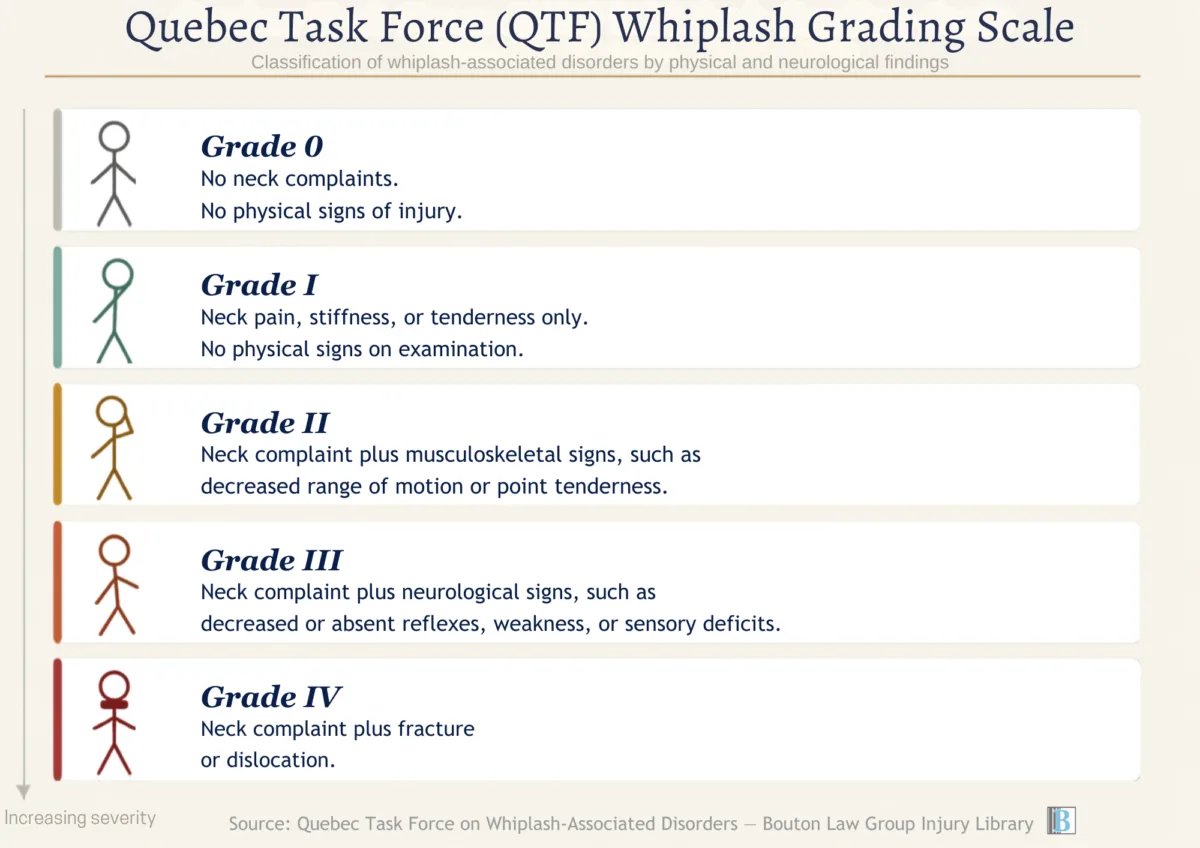
This classification system can be useful for understanding why two people involved in similar accidents can walk away with very different diagnoses. A Grade I injury may resolve within days to weeks, while a Grade III injury involving nerve compression can require months of treatment and, in some cases, surgical intervention.
Types of Neck Injuries Associated with Car Accidents
Whiplash is often used as a general term, but auto accidents can produce several distinct types of neck injury, sometimes in combination:
Cervical strain and sprain
The most common form of whiplash-related injury, involving overstretching of the neck muscles (strain) or the ligaments connecting the vertebrae (sprain).
Cervical disc herniation or bulge
The intervertebral discs that cushion the vertebrae can rupture or bulge under the force of a collision, sometimes compressing nearby nerve roots or the spinal cord itself.
Facet joint injury
The small joints connecting adjacent vertebrae, which allow the neck to bend and rotate, can be sprained or damaged, producing localized pain that often worsens with certain movements.
Cervical radiculopathy
Compression or irritation of a nerve root exiting the cervical spine, frequently caused by disc herniation, resulting in pain, numbness, tingling, or weakness that radiates into the shoulder, arm, or hand.
Cervical fracture
In more severe collisions, one or more of the cervical vertebrae can fracture. This is a serious injury that may involve an existing or future spinal cord injury and requires immediate medical attention.
Temporomandibular joint (TMJ) injury
The same forceful motion responsible for whiplash can also affect the jaw joint, resulting in jaw pain, clicking, or difficulty chewing that is sometimes overlooked as a separate condition from the neck injury itself.
Attorney Boulton’s car accident clients often present with a wide array of whiplash and neck injuries, from cervical strain to disc herniations and fractures. Whether they were involved in low-speed or high-speed collisions, he has a track record of building powerful cases that help to verify and legitimize their injuries and the significant impact it had on their everyday lives and activities.
Common Causes of Whiplash & Neck Injuries
While whiplash is most closely associated with rear-end accidents, it can result from any collision that involves a sudden change in the vehicle’s speed or direction, including:
- Rear-end collisions
- Side-impact (T-bone) collisions
- Head-on collisions
- Sudden braking or evasive maneuvers
- Multi-vehicle collisions, which can subject occupants to more than one force event
- Motorcycle accidents
Contrary to a common assumption, or what insurance companies may claim, collision speed is not the only or even the primary determinant of neck injury severity. Factors such as the angle of impact, the position of the occupant’s head and body at the moment of impact, seat and headrest design, and whether the occupant was braced for the collision can all influence the likelihood and severity of a resulting neck injury.
Signs and Symptoms
Whiplash symptoms vary considerably depending on the severity of the injury and can appear immediately or develop over the following hours and days.
Symptoms that commonly present immediately or shortly after a collision:
- Neck pain and stiffness
- Reduced range of motion in the neck
- Headache, often originating at the base of the skull
Symptoms that frequently develop over the following 24 to 72 hours:
- Shoulder, upper back, or arm pain
- Numbness or tingling in the arms or hands
- Dizziness
- Fatigue
- Blurred vision
- Difficulty concentrating or memory issues
- Sleep disturbance
The delayed onset of symptoms is a well-documented feature of whiplash injury and is one of the primary reasons medical evaluation is recommended as soon as possible after any collision, even in the absence of immediate pain. Delayed presentation does not indicate that an injury is less severe or less legitimate.
If neck pain is immediate and you are experiencing symptoms at the scene of the accident, the investigating officer(s) will typically make a note of this in the accident report.
Below is an excerpt of an Indiana accident report from a case handled by attorney Boulton. As you can see, the accident victim’s injury status was clearly noted at the time of the collision.

It’s important to remember the accident report is often merely a starting point for victims seeking compensation for their injuries. Having an injury noted on a report doesn’t guarantee compensation, and not having an injury listed due to delayed onset symptoms doesn’t exclude you from potential compensation.
Diagnosis and Clinical Evaluation
Diagnosis of whiplash typically begins with a physical examination assessing range of motion, tenderness, and neurological function (reflexes, strength, and sensation). Because whiplash is primarily a soft tissue injury, standard X-rays often appear normal and are used mainly to rule out fracture or bone abnormality.
When a treating physician suspects disc involvement, nerve compression, or a more serious underlying injury, additional imaging may be ordered, including:
- X-ray — used primarily to rule out fracture, dislocation, or bone abnormality
- CT scan — provides more detailed imaging of bone structures, often used when fracture is suspected
- MRI — the preferred imaging method for evaluating soft tissue, discs, and nerve involvement, though it is not always ordered for milder cases
Because a normal X-ray does not rule out a significant soft tissue injury, this distinction is frequently a point of contention with insurance companies for personal injury claims that involve whiplash.
Treatment Approaches
Treatment for whiplash and related neck injuries is generally guided by the severity and stage of the injury.
Acute phase (typically the first 1 to 2 weeks)
- Rest and activity modification, generally avoiding prolonged immobilization
- Ice or heat application
- Over-the-counter or prescription anti-inflammatory medication
- Short-term use of a cervical collar in select cases, though prolonged use is generally discouraged as it can delay recovery
Subacute phase
- Physical therapy focused on restoring range of motion and strengthening supporting muscles
- Chiropractic care
- Massage therapy
- Continued anti-inflammatory or pain management medication as needed
Cases involving disc herniation, nerve compression, or persistent symptoms
- Epidural steroid injections or nerve blocks
- Referral to a spine specialist or neurologist
- In select cases involving significant disc herniation with nerve compression that does not respond to conservative treatment, surgical intervention
Consistency of treatment matters for your health and potential personal injury case. Interruptions in care, whether due to cost, scheduling, or a patient feeling that symptoms have improved enough to stop, are commonly cited by insurance companies as evidence that an injury was not serious, meaning your case may be undervalued or in some cases denied.
Following a treating physician’s recommended course of care, and communicating clearly if symptoms persist or worsen, supports both personal recovery and accurate documentation of the injury.
Recovery Timeline and Prognosis
Recovery from whiplash varies significantly from person to person and depends on the severity of the initial injury, promptness of treatment, and individual health factors.
Published research on whiplash-associated disorders indicates that many patients experience significant improvement within the first several weeks to a few months of injury. However, the same body of research indicates that a meaningful percentage of patients, commonly cited in a range around one in four, continue to experience symptoms beyond the initial recovery window, and a smaller subset develop chronic whiplash-associated disorder, involving persistent pain, stiffness, or headache that can last a year or longer.
The economic impact of whiplash injuries nationally is substantial. Peer-reviewed research has placed the annual direct cost of whiplash-related medical care and lost productivity in the billions of dollars, underscoring that these are not minor injuries in aggregate, even though any individual case may resolve without long-term complications.
Insurance companies are well aware of the impact whiplash cases have on their bottom line, and it’s for this reason they aggressively defend these cases. This is why consistent treatment, documentation, and experienced legal representation are key to successfully recovering maximum compensation for this type of injury.
Potential Long-Term and Chronic Complications
While most whiplash injuries improve with appropriate treatment, some patients experience longer-term effects, including:
- Chronic neck pain or stiffness
- Recurring headaches, including cervicogenic headaches originating from the neck
- Reduced range of motion
- Chronic radiculopathy from unresolved disc involvement
- Development of early degenerative changes in the cervical spine, sometimes accelerated by the original injury
The likelihood of long-term complications tends to correlate with the initial severity of the injury (as reflected in the Quebec Task Force grading above), though outcomes can vary even among patients with similar initial presentations.
Whiplash and Neck Injuries in a Personal Injury Claim
Because whiplash is a soft tissue injury that does not always appear on standard imaging, it is one of the injury types most frequently disputed or undervalued by insurance companies. A few factors are particularly relevant to how these claims are evaluated:
- Documentation matters. Consistent, well-documented medical treatment, beginning as close to the date of the accident as possible, is the primary evidence connecting an injury to a collision.
- Delayed symptom onset is common and does not weaken a claim on its own, though it should be clearly documented and explained to treating physicians.
- Vehicle damage and injury severity are not directly correlated. Minor property damage does not indicate a minor injury, a point supported by the biomechanical research referenced above.
- Gaps in treatment can be used to argue an injury was not serious, even when the gap was due to ordinary scheduling or financial constraints.
- Pre-existing neck conditions do not disqualify a claim, but they can complicate it. Insurance companies will often review prior medical history for any evidence of previous neck complaints and attempt to attribute current symptoms to a pre-existing condition rather than the accident.
Attorney Boulton has spent more than three decades helping Indiana accident victims present properly documented whiplash and neck injury claims and responding to the tactics insurance companies commonly use to minimize them.
Frequently Asked Questions
Is whiplash a “real” injury, or is it exaggerated by personal injury claims?
Whiplash is a well-documented soft tissue injury supported by decades of clinical research and formal medical classification systems, such as the Quebec Task Force grading scale. While its severity varies widely from case to case, it is a legitimate and, in some cases, seriously disabling injury.
Can whiplash occur in a low-speed collision?
Yes. Research has shown that whiplash can occur in collisions under 10 miles per hour, and the degree of vehicle damage does not reliably predict the severity of injury to an occupant.
Why didn’t I feel pain until a day or two after my accident?
Delayed symptom onset is a recognized and common feature of whiplash injury. It does not indicate that the injury is less severe or less legitimate.
Do I need an MRI to have a valid whiplash claim?
Not necessarily. Many whiplash injuries are diagnosed clinically, through physical examination and documented symptoms, without advanced imaging. MRI becomes more relevant when disc involvement or nerve compression is suspected.
How long does whiplash typically take to heal?
Many people see significant improvement within several weeks to a few months. A meaningful subset of patients experience longer recovery periods, and a smaller percentage develop chronic symptoms.
What determines the value of a whiplash claim?
Value is generally driven by the severity of the injury, the type and length of treatment required, the injury’s impact on work and daily activities, and the quality of medical documentation connecting the injury to the accident.
Next Steps for Whiplash Victims
First, and most importantly, you should always seek treatment for an auto-related accident injury, even if you believe it to be minor.
Whiplash injuries can start out mild but eventually worsen over time, leaving victims in worse shape than if they had sought immediate treatment. Likewise, various types of whiplash are also known to exhibit no immediate symptoms following an accident, only to have soreness and pain appear in the days or weeks after the collision.
By seeking professional medical treatment for a whiplash injury, you protect yourself in two important ways:
- You help to ensure your injury doesn’t worsen or result in further complications.
- You build a documented paper trail that can be used to strengthen any resulting personal injury claim(s).
After you’ve sought treatment, attorney Boulton recommends that you contact an experienced whiplash attorney to discuss your potential options to recover compensation as well as protect your legal rights.
Keep in mind, time is always a factor in a whiplash injury claim. The sooner you contact an attorney following your accident, the more opportunity they have to secure evidence and build the most powerful case on your behalf. It also helps to ensure your statute of limitations is appropriately identified and protected, decreasing the risk that your rights to compensation will expire.
About Boulton Law Group
Founded by award-winning attorney Matt Boulton, Boulton Law Group is a top-rated personal injury law firm sought after by accident victims and families throughout Indiana.
Known for its track record of success and hyper-focus on personal service, each Boulton Law Group client has exclusive access to attorney Boulton, who handles every facet of their case from start to finish.
Attorney Boulton’s legal career spans 30 years, and during this time he has maintained a strict focus on helping injured Hoosiers recover compensation and prepare for their post-accident lives. His areas of practice include:
- Car accidents
- Truck accidents
- Motorcycle accidents
- Dog bite injuries
- Pedestrian accidents
- Slip and fall injuries
- Wrongful death lawsuits
- Nursing home abuse
- Negligent security
If you sustained a whiplash or neck injury that was the result of a car accident, Boulton Law Group’s Zero Fee Guarantee means you are always welcome to a free, no-pressure, no-obligation consultation to discuss your potential case and legal options. There is never a legal fee or upfront charge of any kind for clients unless compensation is recovered on your behalf.
To speak with attorney Boulton directly, call 317-350-2680. Or you can write to him with the details of your whiplash and neck injury story by using the firm’s confidential, free contact form.
About This Resource
This page is intended for general educational purposes and does not constitute medical or legal advice. If you have been in an accident and are experiencing neck pain or any of the symptoms described above, consult a qualified medical provider for evaluation and treatment.

Free Case Review
Contact attorney Matt Boulton for a 100% FREE case review. No fee(s) or charge(s) of any kind are ever collected until a client’s case is won.
Awards & Honors
- AV-Rated Preeminent by Martindale-Hubbell
- Multi-Million Dollar Advocates Forum
- Million Dollar Advocates Forum
- Rated by Super Lawyers
- Lead Council Verified
- Better Business Bureau A+ Rating
Zero Fee Guarantee
Our Zero Fee Guarantee means absolutely no fee(s) or charge(s) of any kind are ever collected until a client's case is won.
Talk to Attorney Matt Boulton
